

Communities

640px-mount_stuart_house_2018-08-25-9068561
Communities

Lady Lola’s Off-Grid Lockdown

Lady Lola Crichton-Stuart, 20-year-old daughter of the Marquess of Bute, is having a very laid back lockdown.

She is in isolation on a remote island, near her family’s ancestral home with a gaggle of friends, including her half-sister Jazzy de Lisser, an actress, and model Adwoa Aboah. The group have shared snaps of their wholesome Scottish lockdown on Instagram.

Lady Lola has shared snaps of herself taking dips in the sea, strolling through the countryside, and baking up a storm with friends including Vogue cover girl Adwoa Aboah, 27, and Ruby Boglione, the youngest daughter of Petersham Nurseries founders Gael and Francesco, who works as a buyer for the family business.

It is thought the group is staying at a holiday cottage, rather than the family’s ancestral seat, Mount Stuart Manor House, which is home to Lady Lola’s father and fashion designer mother, Serena, 57. Her father, former F1 racing driver John Crichton-Stuart, 7th Marquess of Bute, takes his title.…

Read More »
Communities

Attenborough flick aims to “end waste”

One of the most potent reasons for living off-grid is the amount of energy that is wasted by the grid. According to academic studies 32% of energy is lost in the transmission system between where it is generated and reaching the end user.

Sir David Attenborough appeared on BBC TV this morning to promote a film he made for Netflix, telling us we have one last chance to save our species. In the interview he urged people to “stop waste of any kind”, saying the world is precious and should be “celebrated and cherished”.

He added that Covid-19 was spread most quickly in the planet’s most densely populated areas – another reason to live in the areas of Exurbia most popular with off-gridders.

The broadcaster and naturalist warns humans have a “last chance” to change their behaviour and save the planet, as he urged politicians to address “the biggest problem humanity has ever faced”.

In an interview on the BBC’s Andrew Marr Show, Attenborough, 93, said it will be the younger generation who will have to make changes because “they will be able to see the consequences of what they do”.

He added: “My lot are dying off and we are the ones that caused the problem.”

He suggested people should see the world and their time in it as precious, saying “that’s the fundamental attitude”.

He warned: “The world is not a bowl of fruit in which we can just take what we wish. We are part of it and if we destroy it we destroy ourselves.”

Asked what people can do to help protect the planet, Attenborough said: “Stop waste. Stop waste of any kind. Stop wasting power, stop wasting food, stop wasting plastic. Don’t waste, this is a precious world. Celebrate and cherish.”

He went on to say that his message to world leaders would be: “This is the last chance.

“There are short-term problems and long-term problems.

“A politician is tempted to deal with short-term problems all the time and neglect long-term problems.

“This is not only a long-term problem it is the biggest problem humanity has faced. Ever.

“Please examine it and please respond.”

Attenborough has worked with Netflix to produce an upcoming documentary called A Life On Our Planet which looks at the challenges facing earth and what can be done to address them.…

Read More »
Communities

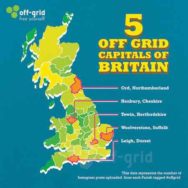
5 Off-Grid Capitals of Britain

The growing interest in living off the grid is a global phenomenon – hundreds of thousands every year are moving off-grid – either because they want to live a cleaner greener life, or because it is a less expensive way to live and allows them more financial freedom – or out of a fear of social and economic collapse, or combination of these factors.

But by the nature of this lifestyle it is low profile to the point of invisibility.

Using online research tools, Off-Grid.Net scraped the Internet and found the 5 UK centres of interest in this lifestyle.

The parishes (the smallest unit of local government in the UK) are in Hertfordshire, Suffolk, Cheshire, Dorset, and Northumberland. These are the places where people take the most about living off-grid, and therefore can be assumed to to be the most interested in living off-grid.

Wolverstone, Suffolk has a huge Marina and as a result many boat-dwellers and van-dwellers are there all the year round. Marina charges are low, and local farmers will allow camper vans or buses to park behind a hedge for extended periods.

Ord in Northumberland is near the Lindisfarne Nature Reserve, so it combines bountiful natural produce with the plants found near the sea, as well as the possibility of sea fishing. It is near the River Tweed which also affords opportunity for living on a boat moored in one of the many tributaries, such as Whiteadder Water.

Henbury, Cheshire is near Macclesfield, with a very low population, and plenty of lakes and small rivers. It is a wealthy area so neighbours might oppose off-grid living if they happened to come across it, and it is home to the world famous Jodrell Bank telescope, so there is top quality internet bandwidth in the area.

Leigh in Dorset is also a very wealthy area, where the local working class cannot find any affordable housing. The landscape is gently undulating and predominantly agricultural, with good quality pasture; cheese and cider are a common product of the area, with at one time every farm possessing an orchard. The small Wriggle River passes through the parish.

Tewin, Hertfordshire is the most densely populated of the 5 off-grid centres. Quintessentially English, with pubs, woods, footpaths and meadows, the parish has 1400 residents of whom over half are in the village of Tewin, a commuter village with a thriving cricket club.

Although it would be a stretch to conclude that there were actually a higher proportion living off-grid in these places, that is also possible. Further research would be needed to prove it. Any academics or others willing to sponsor the research please get in touch at news@off-grid.net

We know of off-grid communities all across the country – but this is the first reliable evidence that interest in concentrated in specific communities.

lt can be hard to find an off-grid community when you …

Read More »
Communities

Send us your footage and photos

This is a shout-out to our readers to ask – please send us thousands of your off-grid photos – hundreds of minutes of video footage of you and your off-grid life. C’mon down to our YouTube channel – you can even star in it – we are looking for off-grid communities or individuals to become our next YouTube stars.

With the amazing Smartphones most of us now possess, we can all make photography and videography a part of our life. We are all citizen journalists.

lease send us your stills or videos using photo and video apps, via Google docs or Wetransfer.com.

You can email news@off-grid.net for more guidance on what to send and how to send it.

If you do not live off-grid – you can still share videos of yourself talking about why you want to live off-grid – especially at this difficult time, when Coronavirus confines so many to their own homes.

We know from emails we receive from our readers how many of you want to flee the city now, and start a new life of self-sufficiency.

We also understand you want to look great in every picture you share on our social media platforms. You can even hire a professional to edit photos, for example using On Click.
But we can also edit the footage for you and please ret assured that whatever you send us will be used to best effect. We want you to look good – when you look good, then we look good. So don’t be shy – send us your most revealing moments and most interesting off-grid technologies and we will take care of the rest.
And it really is very easy to film and shoot stills on a phone camera these days – the only limitation is he amount of memory and the bandwidth to send it to us being included in your tariff – but will all-inclusive phone plans even this is within the scope of many. And if not, just wait until the next time you go into town and then jump on the bandwidth in a cafe or library.

Photo and video apps are a boon, allowing you to edit with just a few taps on the mobile. Stills editing apps can change the look and feel of the photographs, from cropping unwanted objects to the addition of stickers or background. There are a few advanced photo editing apps which allow you to remove imperfections on the face, such as wrinkles, dark circles, and white spots.

Video editing apps can be used to do a basic edit – try Vidtrim, Quik, and Adobe Premiere Clip.

There are multiple reasons to use photo editing apps:
Add stickers
If you want to capture yourself standing outside your off-grid home, you can do it. There are various ways to add and remove elements that are in the …

Read More »
Communities

Rich seek out deserted estates, private islands and luxury apartments

While some of the world’s wealthiest reserve themselves “bargain” apartments in central London for up to £22.5 million, other realty agents representing large landowners say they have been flooded with enquiries from the Middle East and Asia’s wealthiest seeking an investment that can serve as both a bolt-hole from the raging pandemic and a long-term investment.

Mansions and apartments in ultra-desirable London locations like Islington, Kensington and Notting Hill are being shown remotely by agents via 360-degree online tours, allowing prospective buyers to view the property without leaving their home.

Among the properties currently available to view include a six-bedroom Belgravia mansion, on the market with Beauchamp Estates for £22.5million, and apartments in Borough, south London, from Galliard Homes, which are available from £1.3million.

Jeremy Gee, managing director of Beauchamp Estates received interest from buyers from the UK, Middle East and Far East who are looking for a secure investment amid the ongoing stock market crisis. The same is true in the more rarified world of private islands, and while some of these idylls sell for up to US$100 million, others go for as little as US$55,000, a fraction of the cost of the average Hong Kong apartment.

Edward de Mallet Morgan, a Partner with Knight Frank’s International Super-Prime Sales Team in London who specialises in private-island sales, said there had been a clear uptick in interest since the first reported coronavirus cases emerged in Wuhan, China, last year.

“For many who are already interested, the current world situation has meant that their resolve, intention and motivation to find a safe and protected haven for themselves and their families has only increased,” he said.

“As well as a financial investment, a private island would certainly be an investment in health and well-being and in very special family time. For some buyers, this is the key to real wealth – health and happiness and the family.

“For Asian buyers, there seems to be a driver, not only for the best and most beautiful, but to acquire such properties in an environment which is unpolluted and as pure as possible.”

While the coronavirus has spurred buyers to look all over the world, there is particular curiosity about parts of the Americas.

“There’s been a definite uptick of interest in freehold islands in recent months, especially in the Caribbean and Central America,” said Chris Krolow, CEO of Ontario-based Private Islands Inc and the owner of Gladden Private Island, a bonsai resort on the Barrier Reef in Belize that rents for US$3,695 per night.

“Asian buyers are careful investors, looking for a hideaway for their own use as well as somewhere that will bring in money at a later date, whether they develop it or resell it. And a private island is a definite ego trip too.”

Krolow’s company lists nearly 700 properties for sale, ranging from the 2.5-hectare Half Island in Nova Scotia, …

Read More »

Plant nurseries deluged with seed orders as fear takes hold

Brisbane – Friday NURSERIES around the world are experiencing “unprecedented” demand for veggie seedlings as customers try to secure their own food supply ahead of or during the lockdown, amid coronavirus panic.

In Australia, independent nurseries and national hardware giant Bunnings have reported a surge in demand for vegetable seedlings in the wake of the pandemic.

Bunnings’ national greenlife buyer, Alex Newman, said there had been an increase in popularity of seedlings and it was working to ensure additional stock was available where needed.

Near Brisbane, Oxley Nursery owner Caitlin Roy said when her business tried to order vegetable seedlings last Monday their wholesaler was already sold out.

“There’s definitely been a run on them on the weekend, particularly herbs and veggies and some fruit,” she said.

Chadwick Nursery owner Ryan Chadwick said that in just two hours last Wednesday morning more than half a dozen people bought veggie seedlings and by Thursday they were sold out.

He said customers were concerned there could be food shortages at supermarkets.Mr Chadwick said lettuces and cabbages, and other plants where the foliage was the food, were quick-growing beginner crops.…

Read More »
Communities

Super-Rich land-grab for remote real estate

In times of crisis wealthy buyers look for luxury bunkers, isolated compounds, hotel takeovers and other high-end features for doomsday scenarios.

People like Amazon CEO Jeff Bezos sell billions of their shares and place it into cash and highly collectible items like rare artefacts – but mostly its real estate that fits the bill in these pandemic times. And if they are not buying then they will rent.

Survivalist prepping is not a new for many high-net-worth individuals. Wealthy homeowners have long been outfitting their apartments and houses with panic rooms, complete with bars, TVs, and upscale furnishings to have an opulent retreat in the event of a break-in or other crisis.

But now there is a new urgency, and upscale hotels which were thinking to shutter for the crisis, are being approached with offers they cannot refuse.

The buyout

Loungueville House, set in picturesque countryside a three-hour drive from Dublin, Ireland, will be occupied by a single party in May. Francis Lynch, his wife and their two young adult sons will have the nine-bedroom house to themselves, reports CNN.

Lynch and his family, who live in Dublin, almost always travel internationally for holiday, including to Italy, the United States and India. They’ve altered their plans this year, thanks to coronavirus.
“We want to stay in the country and feel safe by being secluded,” he says. The 10-day Loungueville House buyout (for over 25,000 euros) to the rescue.
“When you stay in a hotel with other people, it’s hard not to have social interaction,” says Lynch. “The best way to get close to total privacy and to control your environment is to have the whole place to yourself.”
Siobhan Byrne Learat, the owner of the Dublin-based travel company Adams & Butler, says she has had numerous requests for hotels buyouts in Ireland from her Irish clientele since coronavirus intensified in the country during the second week of March. Several of these requests have led to confirmed bookings (Lynch rented Loungueville House through her).
“The interest in exclusive-use properties has suddenly shot up,” she says. “But people don’t want a full staff and daily housekeeping like they typically would if it weren’t for the virus. They want to keep services to a minimum to avoid interaction with others.”
In the United States, several hotels have started to offer takeovers in the wake of the virus.
Cape Arundel Inn, in Kennebunkport, Maine, is one example.
“This is a new offering we’re implementing for the month of April. We have seen so many of the seasonal summer homes in the area become a respite for folks who live in highly populated urban areas since the virus hit,” says the hotel’s managing director, Justin Grimes.
“We wanted to help offer additional accommodation options for those trying to distance themselves from dense, multifamily urban settings.”
The ocean view upscale hotel has 14

Read More »
Communities

Bikini farmers of California

The Times newspaper has run a feature about a group of women herding cattle and wielding chainsaws in their thongs.

When you first visit the King’s Hill ranch in northern California, there are a couple of things you notice right away. You notice the animals: the sheep and the goats, the alpacas, horses and flocks of poultry.

But more than anything, you notice the girls. It’s hard not to. Because everyone working at King’s Hill is a young woman. Also – and this is important – they really enjoy wearing bikinis. Not all the time. Of course not. That would be impractical. “If we’re working with the animals then we’re not going to be in our thongs,” says Doris Molakides, a slim 39-year-old with long black hair who owns and oversees the 400-acre operation. But, she continues, yes, if it’s hot and they are just doing harvesting work or other farmyard chores then she and her troupe of young seasonal workers will strip down to their beachwear. “I mean, we’re in the sun every single day and we don’t want tan lines. If there are no guys around, we will take our tops off.”

You notice the remoteness, the acre after acre of sun-drenched farmland spread across rugged green hills, miles from the nearest town. You also notice an intense sense of industry, from the rumble of coming and going pick-up trucks to the distant buzz of chainsaws felling trees.

Now and then, some of them will strip down to nothing and go about their busy day of commercial agriculture. “We’ll get naked,” she says brightly. “We oil ourselves up and get pruning.”

What is this place? Why is it worked exclusively by cheerful, body-confident women? Why is one of the girls, Lexie, feeding chickens while wearing what I can only really describe as a G-string? Why is Molakides practising her marksmanship with an automatic rifle – she has completed several tactical shooting courses – in a tight, white miniskirt? What’s going on? I am, for better or worse, not actually at the King’s Hill ranch. Instead, like many thousands of other people, I have been following events here on Instagram. Molakides runs an account called @GirlsGoneOffGrid in which she documents daily life on her selfsufficient, off-grid ranch. It shows Molakides and her fellow workers helping their goats to give birth, harvesting walnuts, slaughtering turkeys and, until a recent change in the law prohibited them from doing so, cultivating industrial quantities of marijuana. Often while wearing bikinis.

For some reason, Molakides says, many people look at these images and videos and assume they are contrived. “There are so many people commenting like, ‘Oh, this can’t be real! This is fake!'” she says. But it really, really is real. “I guess I just wanted to document what we were doing. It wasn’t for show. It wasn’t for anything,” she …

Read More »

7 Best US Colleges for Cleantech

Clean technology (like renewable energy, or low carbon production processes) are in demand across advanced economies in US and Europe. From folks interested in involving cleantech in their daily lives, to companies wanting to prioritise the environment for the next generation, cleantech is the future. If you are soon to leave High school, and you feel like you are made for this mission, then the following renewable energy engineering schools are worth considering. 

Stanford University
Situated Silicon Valley, it’s graduates were responsible for the creation of such IT companies like Hewlett-Packard, Sun Microsystems, Yahoo!, eBay, and Google. More than 50 Stanford professors are Nobel Prize winners. 90% of graduates are successfully employed during the first few months, and their graduates are generally better paid than other prestigious universities in the United States. 
Oregon State University
It’s one of the two universities in the USA that get government grants for land, ocean, space, and renewable energy research. Students from 48 states and 120 countries study there, and each student can get his alternative energy degree in this school. The teaching staff is proud of annual government support that exceeds $ 280 million. You can be sure that you get substantial knowledge as the student groups consist of from 12 to 20 students that allow the teacher to pay more attention to each student.
California Institute of Technology
This university is also known as Caltech. Cosmology has long been one of the university’s priorities. Caltech works closely with NASA, launching most of their spacecraft. The teaching system at Caltech differs from the traditional rivalry of American students — Caltech’s policy encourages teamwork and homework, thus encouraging collaboration at the student level. When you ask the writing service, “Can you do my math homework for me online?” you may well find it is graduates of this college who come to your assistance. Or you can pull together and do it on your own!
The University of Texas at Austin
The university is one of our particular favourites. It consists of a group of colleges and schools that offer programs in communication, pedagogy, arts, humanities, natural sciences, pharmaceuticals, further education, higher education, engineering, geoscience, social relations, business, architecture, information, law, etc. Most students are attracted by its research centers throughout the country, including the D.D. Pickle Research Campus,MaxPot, and Institute of Marine Science. More than 50,000 students get their degrees in cleantech from Austin each year.
Massachusetts Institute of Technology
MIT is a world leader in the field of science and technology. The university traditionally tops the world rankings. Its spending on research exceeds $650 million per year, with funds coming from public institutions such as the Department of Health and Social Services and the Ministry of Defence.
University of Maryland
This school is considered as the best university for renewable energy engineering. It’s among the top 30 universities in the United States. …

Read More »
Communities

Reuters Foundation turns on to off-grid

Here is a recent Reuters Foundation report on off-grid real estate:

Often called survivalists or “preppers”, many escapees twin an expectation of impending doom – or outright social collapse – with a deep disbelief in the government’s ability to cope.

Buying land — or “bugout” property, derived from military slang for a retreat — is a priority, with real estate networks compiling national lists of “prepper lands”.

Most survivalist land purchases are in the mountains of the U.S. northwest, primarily Idaho, Montana and Wyoming.

In 2011, a blogger and former U.S. Army intelligence officer named James Wesley, Rawles – he includes the comma in his name – wrote a widely circulated post urging “freedom-loving Christians” to move to the region as a safe haven.

He dubbed the area the American Redoubt and urged followers to “buy land that will maximise your self-sufficiency.”

It is unclear how many heeded his call, but the Economist magazine estimated they numbered in the “thousands of families”.

Idaho in particular recorded a big influx, says Reuters Foundation.

The state had one of the top U.S. growth rates in 2015-16, driven in part by escapees from California and neighbouring Washington state, according to Boise State assistant professor Jeffrey Lyons.

Disaffected Californians make up a substantial number of clients for Black Rifle Real Estate, which says online that it helps people “Flee the City to the freedom and safety of Rural America and the famed American Redoubt.”

Broker Todd Savage said his business is at an all-time high, driven by frustration with how many U.S. cities are governed.

“Most of our clients are now looking to sell their postage-stamp size properties … and make what we call a ‘Strategic Relocation’ to a free state,” Savage said in an email.

Driven by new demand, the company is expanding outside of the so-called Redoubt — to Arizona, which Savage said enjoys lower taxes and far looser gun controls than liberal California.

“Arizona is the new Idaho for many seeking relief from the tyranny in California,” he said.

EMBRACE LAND

Conservatives are not alone in the new land rush.

Haynes said his clients in North Carolina are evenly split between survivalists and “homesteaders” — young, liberal, less affluent families seeking peace, quiet and a sustainable life.

“When I started out in 1973, the big thing then was the ‘back to the land’ movement,” said Neil Shelton with the Ozark Land Company, a developer active in Missouri and Arkansas.

What he is seeing now is a “new iteration” of that movement, he said, and one driven by innovation: the pre-built ‘tiny home’, typically 400-600 square feet.

Small structures have made home ownership more affordable, he said, for some accelerating the new mood of escapism.

“This tiny-house movement is the biggest thing I’ve seen since” the 1970s, Shelton said.

Kim Moore, 63, said she and her husband had bought nearly 60 acres …

Read More »
Communities

How UK govt could help off-grid communities

Its time to stop looking at the thousands of people who live in off-grid communities as strange throwbacks. They are the future, not the past.

(If you have come here from the BBC Radio 4 show looking for offgrid.com – you are in the right place, by the way. If you have not you may wish to listen to it at this link)

There are many reasons why people choose to live off-grid – and although it is not for everyone, there are tens of thousands in the UK alone who are desperate to get away from consumerism, traffic, jams, rapacious landlords, and working just to pay the rent.

Then there are people who want to reduce their carbon footprint – the damage they cause every day to the planet. now we are being told we all have to reduce our carbon footprint.

The UK’s former chief science adviser, Prof. Sir Ian Boyd said that technology alone will not allow us to avoid the pain of carbon reduction. The main thing we must do is “reduce demand” for energy, fuel, food, clothing, and everything else. Over the past 6 years since carbon targets were set, said Sir Ian, the government failed to offer incentives to assist the public in making those changes. It can use the tax system do so in the future. Carbon tax is a stick. Successful policy will also need a carrot.

That provides an opening for an environmental policy that offers, at least to some, an immediate change in their daily lives. For all who yearn for a more “natural” way of life.

For about the same price as the Thomas Cook airlift, the UK Govt could immediately enable several dozen experimental off-grid communities – eco-villages of 300 homes, which can grow to be small towns over time. This could satisfy the pent=up demand of hundreds of thousands of voters and simultaneously advance other key policies in the areas of energy, housing, and rural affairs.

At a time when housing in this country is facing multiple crises – of affordability and of supply and, in the case of social housing, of funding and of allocation – we need to be willing to embrace brave and new solutions.  Off-grid settlements – historically a fringe interest in the UK, although they have a long history in other countries, including the US – offer an important new alternative.

They help solve four problems:
 
• Cheap housing – how to enable it
• Energy use – how to reduce it
• Food Security – how to improve it
• Rural Regeneration – how to kickstart it

A policy which offered £50-100 million over 3 years toward launching dozens of these communities would test to destruction the level of genuine demand for such a lifestyle among our army of rebellious eco-warriors, as well as many other groups who for reasons of …

Read More »
Communities

California’s original off-grid store relocates

Real Goods, the California-based original purveyor of off-grid living supplies, has relocated to Ukiah, California. The move follows the companys acquisition by altE Store in September of this year. Real Goods second ever store was also located in Ukiah.

Real Goods new business address is 2005 N. State St., Unit G, Ukiah, CA 95482. The new location, about two miles from the city center, will have office space and a larger warehouse. The larger warehouse allows Real Goods to offer a greater selection of solar energy products and systems, and faster shipping to West Coast customers.

The move follows the September 2019 acquisition of Real Goods by altE Store. Now powered by altE, the Real Goods sales and customer support teams continue as part of the altE family. altE CEO Sascha Deri commented on the move, “Our new warehouse will more than double the inventory capacity of Real Goods. This move enables us to not only provide a wider range of renewable energy system products to our local customers in the Mendocino County area but also decrease shipping costs to our customers on the entire West Coast.”

As part of its acquisition, Real Goods has begun offering competitive wholesale programs for professional solar installers in Arizona, California, Colorado, Idaho, New Mexico, Nevada, Oregon, Utah, and Washington state, with expanded inventory and distributor pricing. To apply, call Real Goods at 800-919-2400.

Formerly EcoTerra, the Solar Living Center remains in Hopland, California. The Center continues to be a home to the Solar Living Institute, Solar Living Store, and Emerald Pharms. For more information, find the SLC online at https://solarliving.org/slc/ or call (707) 472-2456.…

Read More »