

Energy

John Berger of Sunnova on Bloomberg TV
Energy

Judge halts Sunnova bid to power new homes off-grid

A California regulatory judge preliminarily rejected a move by Sunnova Energy, one of America’s biggest rooftop-solar companies, to serve as a micro-utility to new residential communities in the state.  The company was trying to use an obscure law relating to a 1920s ski resort to force its way into the highly regulated electricity Utility business.

A formal rejection would be a blow to residential solar and battery providers that have begun eating into the customer base of California’s big three privately-owned utilities — PG&E Corp., Edison International and Sempra Energy’s San Diego Gas & Electric. All three have fought to protect their territories as new technologies have eroded their monopolies.

Texas-based Sunnova, in September submitted an application to the California Public Utilities Commission to build and operate microgrids as part of new master-planned residential communities. But an administrative law judge said in a proposed decision issued Tuesday that Sunnova had failed to provide the information required for a so-called certificate of public convenience and necessity.

Sunnova is one of the biggest US corporations at the forefront of the struggle for more rights for off-grid energy producers.  It supplies solar rooftops under a variety of innovative financing arrangements, allowing property owners to install now and pay later.

Extreme weather and higher electricity prices are leading American households to bolt a record number of solar panels to their rooftops, loosening ties to the power grid and the utilities that run it. About 5.3 gigawatts of residential solar power capacity were installed in 2022, the biggest year for new installations and roughly equivalent to total rooftop solar capacity nationwide in 2015, the US Energy Information Administration has said. Installations jumped about 40 per cent year on year with about 180,000 US homes adding systems in the second quarter, according to data compiled by consultancy Wood Mackenzie. Home electricity prices rose only 7.5 per cent in 2022 – compared to much steeper rises in Europe,  and 4.3 per cent in 2021.

Rates have climbed largely because of higher prices for natural gas used to fuel power plants. “You’re going to continue to see some pretty big increases in monopoly utility bills over the next few months and quarters and we’re seeing growth because of that,” said John Berger, chief executive of Sunnova.

Berger said the utilities were defending a “Soviet-style” system that prevents competition in the power sector because they worry that the growth of home solar will eat into their market. “Consumers don’t have choices. They don’t get to choose their power provider, and I think they should be able to and I think more and more people are demanding that,” he said.

Executives and analysts also point to the numerous storms, heatwaves and fires across the country that have exposed deep vulnerabilities in the reliability of power grids across the US. Hurricane Ian last month knocked out power to 2.6mn customers in …


Read More »
Energy

US Food Corps Turn Away From The Grid…Along With Google and Big Govt.

Power outages are even more costly to food producers and distributors than they are to the rest of us. Loss of refrigeration can mean loss of product. Safety rules often require shut-down and sanitizing even if the outage is short. So it’s not surprising that the food industry is turning to off-grid for more reliable electric supply.

Bluehouse Greenhouse, which specializes in sustainable indoor agriculture has hired developer Endurant to build an off-grid microgrid for the company’s 2.8 million square ft. greenhouse. The highly-automated glass structure will produce 50 million pounds of fresh produce annually.

Why go off-grid?

Bluehouse Greenhouse decided it was too expensive and too difficult to interconnect with the grid. “We had to think about what is the most resilient solution, where are we going to get the most benefit for our money and investment, and where are we going to have the most secure energy system,” said Ari Kashani, CEO and founder of Bluehouse Greenhouse.  Most microgrid developers find that grid-connection approvals significantly delay their projects. Will others follow the Bluehouse Greenhouse model?

And another two!

Most North American microgrids are grid connected, allowing them to take services from the grid or sell services to the grid as needed. But Taylor Farms is going entirely off-grid. The major California fresh food producer is building a standalone power supply in partnership with Bloom Energy, Ameresco and Concept Clean Energy.

Almond World, a refrigerated cold storage developer in California’s Central Valley, is another food facility that is taking its energy operation off-grid. The company has partnered with Origo Investments to build a facility in the Madera Airport Industrial Park that will include an off-grid microgrid designed and built by Scale Microgrid Solutions.

Bimbo Bakeries, the maker of such products as Thomas’ English muffins, Arnold bread, and Sara Lee and Entenmann’s pastries is installing microgrids to meet its sustainability goals. The company announced plans in 2022 to install microgrids at six manufacturing facilities over the next year with the help of GreenStruxure, a subsidiary of Schneider Electric.

And there’s more…

But its not just food companies which are going out on their own.  Sunnova  – the rooftop solar company – has gone into housing development to provide itself the rooves it needs.

It’s not always easy to develop community microgrids because they clash with the conventional utility model. So Sunnova has proposed a new approach — microutilities that operate standalone facilities in newly built California neighborhoods of fewer than 2,000 customers. The plan requires state regulatory approval.

Like Sunnova, Cuyahoga County, Ohio, sees outdated utility rules getting in the way of energy development, so it is creating its own utility company. The county utility will oversee multiple microgrids built to encourage economic activity and improve energy resilience.

Even Energy companies are going off the grid!

Entergy is among many existing utility companies investing in microgrids as part of its …

Read More »
A Husk micro-grid plant in Nasarawa, central Nigeria. Photo supplied.
Energy

Nigeria grows off-grid power

Nigeria announced in 2017 that it would no longer be pursuing a national grid strategy, but instead would develop island power in specific areas across the nation of 231m people. For example, Husk’s six new microgrids have been developed simultaneously in Nigeria as part of a rural electrification program backed by the World Bank. The projects show the considerable possibilities available from the scaling up of microgrid rollout programs.

Located in Nasarawa State, the solar hybrid microgrid projects provides clean, reliable and affordable electricity to about 5,000 households and 500 businesses. Six communities in the Doma and Lafia local government areas will gain access to electricity for the first time. Communities benefiting are Rukubi, Idadu and Igbabo in Doma and Kiguna, Akura and Gidan Buba in Lafia. Developed by Husk Power Systems, the projects will also support local agricultural activities. Manoj Sinha, founder and CEO of Husk Power Systems said: “We have made great progress in rolling out new minigrids and we’re seeing high rvenue per customer at our first 6 sites. We see a potential to add another 500 minigrids in Nigeria over the next 4-5 years.”

Husk is an Indian company that set up in Nigeria after the African country adopted India’s 2016 minigrid policy verbatim in 2017. However, Nigeria proceeded to add minigrids to their national electrification plan and created policies for DISCOMs to integrate with minigrids.

In Juanary 2023 Husk Power Systems secured funding from Germany’s development finance institution DEG to build 8 new community solar microgrids in Nigeria.

DEG allocated the funds from its Up-Scaling Program, which is co-financed by the Federal Ministry for Economic Cooperation and Development. The 5-year loan in the amount of $749,000 follows Husk successfully closing debt totalling $10.3 million from EDFI-ElectriFI and IREDA in 2022 to build over 200 microgrids in India.

Sinha, of Husk added: ”Access to affordable debt is critical to scaling solar microgrids in Nigeria, home to 90 million people living without access to electricity. This financing provides Husk with a solid foundation for unlocking additional debt, including local currency debt, this year and beyond.”

The DEG financing is the first debt raised by Husk for its business in Nigeria, where the company currently has 12 operational microgrids, and a target of building 500 by 2026. The 8 microgrids in Nigeria will connect more than 500 residential and commercial customers, reduce the number of diesel generators in use by 400, while creating about 40 new direct local jobs.

Petra Kotte, Head of Banking and German Business Division, DEG: ”Husk is exactly the type of company we’re looking for at the Up-Scaling Program, which supports innovative greentech business models in emerging markets that demonstrate high development impact and a significant reduction of carbon emissions.”

www.huskpowersystems.com

Read More »
Energy

Choosing a Turbine to Generate 5KWh from a Waterfall, River or Stream

Generating electricity from a river or waterfall can be a great way to access sustainable energy more reliably than solar or wind, and all year round. Effective power generation requirements vary from case to case.  Consider the different types of turbines available and their specific application. This guide discusses the three main types of turbines suitable for generation: Pelton wheel, Francis turbine and Kaplan turbine. It is hard to provide guidance on commercial products that would work best for each system configuration because of lack of supply and constantly fluctuating prices.  If you are a supplier or a customer with useful experiences, please leave details in the comments including URLs. However, the info below gives all you need to search out products in your own area.

Why generate 5KW from a waterfall or river?

Hydroelectric power generation has been around for centuries, but the latest technologies are more efficient, allowing greater amounts of power to be generated with less impact on the environment. Hydroelectricity is clean and sustainable energy, and more cost-effective than traditional sources such as coal-fired plants or petrol generators. Not only does this reduce carbon footprint, it also takes advantage of one of nature’s most abundant resources: running water. Harnessing the power of rivers and waterfalls offers benefits in terms of reducing air pollution from burning fossil fuels as well as providing local jobs installing and maintaining these systems. With careful planning, 5KW turbines can not only provide enough energy for homes and businesses but can also feed excess electricity to neighbours (or into the grid).

The best turbine to generate 5KWh from a waterfall or river

The choice of turbine will depend on the specific conditions of the site, in particular water flow rate and head.  Water flow is how much water passes through the hydro plant, and head refers to water pressure -ie how hard/quickly it flows. In general, Pelton wheel turbines are ideal for high head sites with lower flow rates, whereas Francis turbines are better suited for medium-head sites with higher flow rates. The Kaplan turbine is suitable for low head/high flow applications although it tends to be less efficient than other types of turbines due to its complex design.

Pelton wheel: best suited for high head, low flow applications

The Pelton wheel turbine is  the most popular type of turbines for hydroelectric power and likely to be the least expensive. It is suitable for high head and low flow applications, where the water pressure is greater than the flow rate. It works by using a series of buckets or cups which capture and redirect the water’s kinetic energy as it passes through them to spin a shaft connected to an electric generator. You will also need to buy a generator like this one. The buckets are angled in such a way that they capture more force from each wave as it …

Read More »
Communities

Utility Company Bosses Disliked By 42% Of Their Staff

Its not just customers who dislike Energy and Utility companies with a passion. Company bosses in the Energy and Utility indsutries are amongst the most hated in British society – by their own employees.

A new survey finds that 42% of energy and utility employees don’t like their bosses – they are the fifth most hated in the UK, just behind Healthcare and Construction – both notorious for arduous working conditions.

Meanwhile the charity Citizens Advice says an estimated 600,000 people were forced to make the switch away from credit meters after racking up debt with their energy supplier in 2022, compared with 380,000 in 2021.

The charity fears a further 160,000 people could be switched by the end of winter if no further action is taken, and is calling for an immediate ban on the use of court warrants.

Any employees of Utility companies who are involved in action against vulnerable clients are encouraged to contact us in confidence at news@off-grid.net

Employee attitudes to UK Energy bosses were exposed in the study carried out by Reboot, which asked 3,445 people from 29 different sectors whether they liked their boss, and if not, what were the main reasons.

The survey found that ‘Being underpaid’, ‘micromanagement’ and ‘lack of communication’ are the most common reasons energy bosses are disliked.

The ten most common reasons for people hating their bosses (%):

being underpaid 66

micromanagement 46

lack of communication 43

ungrateful 27

bullying 24

generally annoying 24

lazy 15

conflicting personalities 12

condescending 12

incompetent 9

 …

Read More »
Energy

Rooftop Solar Incentives – Win Some, Lose Some

From Inglewood to India, via Slovenia and Spain, rooftop solar funding is in a state of flux.

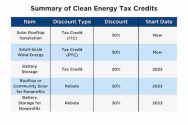
While California has suspended its statewide incentives, the Federal Inflation Reduction Act (IRA) has funding for the next  decade,  Households that outfit their homes with rooftop solar can receive a tax credit under the IRA to cover 30% of the cost of installation, effectively knocking the cost of installing solar down by thousands of dollars. To use the tax credit, you can install solar power on your property, but you must use a licensed solar installer certified by an organization like the North American Board of Certified Energy Practitioners, which adds to the cost — effectively cancelling each other out.   According to the Center for Sustainable Energy, the average size for a residential solar system is 5 kW, costing around $20,000. At that price, the claimable tax credit would be $6,000.

The tax credit for solar is set to last until 2032, at which point it will lower and then expire in 2035 unless Congress renews it.

In California, according to a recent study reported in The Bee, California lacks a specific plan to achieve ambitious goals to reduce pollution by 2030. That’s no surprise in light of Pacific Gas and Electric Co.’s skyrocketing rates and the California Public Utilities Commission’s recent passage of regulations that reduce “excess” solar production credits to ratepayers by 75%. “Just when we need to encourage more people to buy electric cars, Gov. Gavin Newsom and the PUC implement rules that will help kill home solar sales,” says an opinion piece in the Bee. They talk a good game, but how about putting some walk into all this talk? The writer calls for repeal of the solar regulations and drastically reduced utilities’ rates.

Meanwhile, under Slovenia’s just-announced incentive scheme, subsidies for rooftop solar systems with batteries are ten times higher than for those without them. Households and firms could get up to EUR 500 per kilowatt-hour of installed capacity of a facility with batteries, and only EUR 50 for PV systems without storage (down from EUR 180). Subsidies cannot exceed 25% of the total investment.

However, not all batteries are eligible for the incentives. Households and firms must install storage with a capacity of 0.7 hours of operation of the capacity of installed solar power plants. A 10 kW PV system must have a 7 kWh battery.

As Europe’s sunniest country, Spain was one of the leaders in solar power at the start of the century until the 2008 financial crisis halted the boom.

Since then, it has fallen behind neighbours.

A right-wing government threw shade on the sector by cutting subsidies. It then introducing a tax on households that sold excess electricity to the national grid, a move derided by critics as a “tax on the sun”.

But the tax — which NGOs say …

Read More »
Energy

Florida Energy Bills Rocket

Power companies in Florida are warning residents of another major increase in your electricity bill.
A request sent by FPL and Duke energy in December to raise rates by over 10% has been approved by the state regulators, stating that even the power companies are struggling with the fuel prices.
The average monthly bill will be increased by up to $5 according to FPL, but for Duke energy consumers, it will be raised by almost $20.
With this news, the energy companies are providing tips for customers on how to save power through their websites, as well as payment plans for those who are struggling financially.
Small businesses are cutting back the best they can, but with the current prices being the highest in more than 10 years, the uncertainty is also rising. Local residents talk of dreading the months ahead, and ideas of moving over to solar energy are being raised.
See more on this story here

Read More »
Communities

US energy grid buckles – but who is to blame?


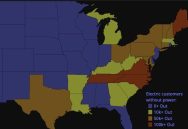
Tennessee 205,982
North Carolina 184,920
Virginia 140,331
Maine 104,068
Pennsylvania 98,101


Over 1.5 million Americans were without power today as storms and sub-zero weather gripped the country.  The ageing electrical grid is expected to come under further pressure by nightfall, leading to questions about how companies like National Grid, PG&E and ConEdison are policed, and fined, when foreseeable events lead to major outages.

The energy companies will be lining up their excuses, but as a vital part of national infrastructure, their obligation is to predict and prepare for weather events.

Check out our short video history of the US Grid for the full background


 …

Read More »
Energy

Queues Around the Planet for Grid Connections

West London, UK – 17.12.2022. A huge housing development on the West side of UK capital city has had to be postponed because the developers cannot obtain a grid connection for another ten years. The problem is overloading of grid capacity due to renewables which need access intermittently at unpredictable times – meaning the grid owners cannot plan ahead and have to leave surplus capacity unused.

It will take up to a decade to bulk up grid capacity and get developments under way again in three west London boroughs — Hillingdon, Ealing and Hounslow. In those boroughs, “major new applicants to the distribution network . . . including housing developments, commercial premises and industrial activities will have to wait several years to receive new electricity connections”, according to a note from the Greater London Authority which oversees the capital’s utility infrastructure.

Part of this is just bad management by the company National Grid which is also coming under criticism for its operations in the Eastern United States. Part of the problem lies with Utility regulator Ofgem, which has, worryingly, just been awarded responsibility for the future planning of the UK electricity supply.

The problems faced by London are also popping up everywhere else in the world, as the huge demand for renewable energy installation come up against the realities of the current, ageing grid network.

The projects go on waiting lists that can now stretch for years, and many ultimately drop off when the delays become intolerable. In the United States, according to reports in the New York Times, enough renewable energy projects are backlogged right now to achieve a largely clean electric grid by 2030. But without urgent action, most are unlikely to get built.

It is the smaller, local power lines running through state-designated transmission corridors that are the main problem. Strung alongside interstates and highways, they were designed decades ago and are just not fat enough to carry more electricity from solar and wind projects. Unless these lines are upgraded with new wires, connecting too many wind or solar farms could cause the cables to overheat, leading to power outages.

Electrical utilities have been caught flat-footed by the falling costs and rapid growth of renewable energy, says the NY Times. “They simply failed to get ahead of the wave and upgrade their wires, and the state governments that oversee the power business neglected to hold them accountable.

“In every state, a public utility commission is charged with regulating the power business, and for too long the decisions of these bodies have flown under the radar. As the climate crisis worsens and our goals for limiting the damage slip farther out of reach, citizens need to show up and make clear to the utilities and their regulators that they want action now.”…

Read More »
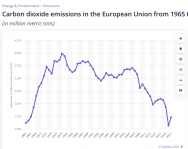
Carbon Dioxide emission in the European Union - 1965-2021
Energy

EU owe $11.36 TRILLION to Cop27 Loss & Damage Fund – new report

Calculations by Off-Grid.net show the EU total liability under the new Cop27 agreement announced in Egypt today, is $11.36 trillion.

Assets of the Loss & Damage fund are currently standing at zero, but countries will be under pressure to contribute quickly. The speed at which this should be paid is open to debate and clearly depends on what each country can afford, but the total EU bill is relatively easy to calculate.

About $2 trillion of the $11.4 trillion is directly attributable to the EU itself, rather than being owed by its 27 member countries, because the basic tenets that the European Commission has promoted since it was first founded in 1952, encouraged, indeed coerced, its member states to burn fossil fuels.

Loss and damage refers to the most severe impacts of extreme weather on the physical and social infrastructure of poor countries, and the financial assistance needed to rescue and rebuild them.

It was the most contentious issue at the COP27 conference, and has been a long-running demand by developing countries since 1992. For nearly two weeks, the EU and the US refused demands from poor countries for a new fund to address loss and damage, arguing that existing funds should be redirected for the purpose. Early on Friday morning, the EU made a U-turn, to agree to a fund on condition that big economies and big emitters still classed as developing countries under the UNFCCC rules, which date back to 1992, should be included as potential donors, and excluded as recipients.

From its very first moment, the EU was all about burning energy – it had been brought into being to foster the burning of coal, the production of power, and the regulation of giant corporate interests.

It launched in 1952, called the European Coal and Steel Community (ECSC). In 2002 Romano Prodi said: “The ECSC was a courageous and hugely significant leap forward for Europe. It was Europe’s first step in pooling a part of each country’s sovereignty for the greater good of all who took part. It was the ECSC which first established shared, supranational institutions for Europe – the basis of the EU as we know it today and a milestone in political history. History will record the founding of the ECSC as a defining moment.”

The stated aim of the ECSC was “economic expansion, employment and better living standards.” They achieved all three – but at what cost?

The Coal and Steel Group had a High Authority to:

• supervise the market;
• monitor compliance with competition rules; and
• ensure price transparency

The aim of the 1952 treaty, as stated in its Article 2, was to contribute, through the common market for coal and steel, to economic expansion, employment and better living standards. Thus, the institutions had to ensure an orderly supply of coal and steel to the common market by ensuring equal …

Read More »
Courses, guides & tutorials

Be off-grid ready – Power yourself up with this battery-panel combo

If you want to Work From Anywhere, and you need to make sure you never run out of power, then this pairing will allow you a couple of days heavy usage to charge a laptop and cellphone (*assuming 4 hours of daylight solar charging per day).

The first is a BLUETTI Portable Power Station AC200MAX,for under $1900 at time of writing. A 2048Wh LiFePO4 Lithium Battery, weighing about 60lbs (Expandable to 8192Wh w/ 4 2200W AC Outlets (4800W Peak), 30A. Find it at  https://amzn.to/3Evf8zK in the USA, and the same kit about £2000 in the UK

Amazon is offering the Renogy 400W Monocrystalline Solar Off-Grid RV Kit for just $514.42 shipped in the US. https://amzn.to/3GlXoYW and £700 in the UK. In the UK you might prefer to go with this 200W Portable Solar Panel Suitcase for £349. It will not give you the power of the 400W of the RV kit, but its cheaper, lighter, and if you sometimes charge your battery from the mains and just use the panel in an emergency, it would be a cheaper solution.

the US deal is down from a normal rate of $600 or more at Amazon, and today’s deal marks the best US panel price that we’ve tracked so far in 2022. This kit has the ability to output up to 1,600Wh per day with just four hours of sunlight availability. You can install the system on top of an RV, home, boat, or anywhere really. Included in the package is four 100W solar panels, a 30A PWM LCD charge controller, mounting brackets, cables, and much more so you can get up and going with off-grid power as soon as it arrives. So, if you’re looking for a way to power your office – whether off-grid or during a blackout, then the above are a solid choice.

Check out more of our UK recommendations here

Read More »
Events

Progress on Disclosure only Success of COP27

As President Biden prepares to address Cop27, it is already clear that “the world’s last chance to conquer climate change” will end in failure.Newsflash: 1.5 degrees is dead and buried.

None of the largest emitters are sticking to pledges made at earlier meetings. China, Russia and India have not even sent their leaders. No wonder campaigner Greta Thunberg is boycotting COP27 – dismissing it as “Greenwash.”

Among an increasing clamour for advanced western economies countries to pay “reparations,” some of the world’s worst carbon emitters (China, Brazil) are hiding behind a smokescreen of historical confusion. At least 20 per cent of historical carbon emissions took place before the industrialisation of the advanced economics since 1850. China has been burning coal for millenia. It had a booming iron and coal industry through the Tang and Song dynasties. In the 11th Century it was burning several hundred thousand tonnes of coal annually. And if you include deforestation as well as fossil fuel in the calculations, Malaysian and Argentina are as much to blame as UK – or China, which is currently the world’s largest emitter and set to increase.

Meanwhile the world’s energy companies are using Cop as a set of useful idiots to push through their plans to receive over $100 TRILLION for decarbonising the world’s energy grids – i.e. paying them to clean up the mess they created in the first place. It would be the most spectacular example of greenwashing in history.

But one little-noticed factor does justify the whole COP process and stop me at least from dismissing it as a complete waste of time. The giant global project to quantify our emissions is gathering pace.
The EU is finalising disclosure rules for 50,000 companies in the 27-country bloc to report on environmental, social and governance (ESG) factors, as well as a company’s impact on the environment, known as double materiality. (https://www.reuters.com/business/cop/cop27-sustainable-standard-setters-close-regulatory-gap-2022-11-10/).

This initiative is a vital building block, and our last best chance to at least reduce the level of damage. Even though its too late to save 1.5, it is better than nothing.…

Read More »