
Energy

Energy

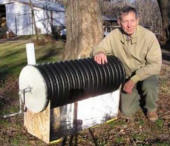
Stirling Work

stirling
The closest thing to free energy

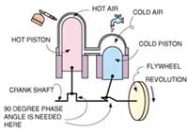
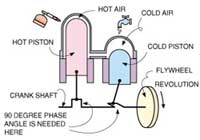
Jamil Shariff is one of the world’s leading researchers into the ancient technology of Stirling Engines – he reveals why they are about to undergo a revival:

Local governments in the US are starting to develop their own strategies for energy-independence, or micro-grids. One little-known technology, the Stirling Engine, is being revived because it can make use of waste heat from other energy sources.

In Helena, MT, city commissioners are designing a project to cut utility bills by generating electricity at the wastewater treatment plant, the city government’s biggest energy user. Camp, Dresser & McKee Inc. are drafting plans for a Stirling engine and generator, which will use excess methane gas at the plant to generate electricity.

The technology likely will cost several hundred thousand dollars but could pay for itself in as few as five years. So what is a Stirling engine exactly, and why are they not more widely used? If the explanation below is too technical, try Building a Stirling Hot Air Engine (2 Video Set). Click “more” for the rest of the story

Read More »

Now concentrate

solar cookers
Mirror, mirror on the floor…

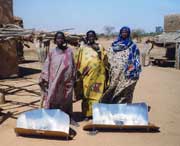
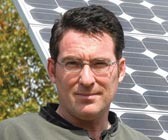
Concentrating solar power (CSP) systems could be the energy of the future in off-grid locations, both small and large scale. Lenses or mirrors focus a large area of sunlight into a small beam. In power stations the beam shines on a vessel that contains a gas or liquid that can be heated up to around 400C (750F) enough for conventional steam turbine. Small-scale off-grid CSP power stations don’t have to be hugely expensive either.

In fact, the basic idea of concentrated solar power is the same as in solar cooking and new methods of water pasteurization – already widely used in the third world – eliminating the need for biomass as a fuel.

But what makes the plants really efficient is their recycling of energy.…

Read More »
Energy

Making fuel from manure

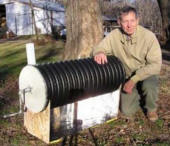
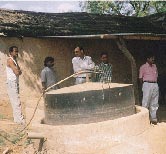
Al Rutan and his tabletop digester
Al Rutan & tabletop digester

The production of natural gas (CH4) occurs everywhere in nature in swamps, bogs, coal mines, land fills and in the guts of warm blooded mammals. In fact, anyplace where organic matter is present and air is excluded.

It is this same vapor gas that the utility companies market. Made by nature and deposited in the ground over eons of time, the chemical formula is one part carbon to four parts hydrogen (CH4). …

Read More »
Courses, guides & tutorials

Next Post

smart power, William Kemp, Renewable Energy, Home Power, …

Read More »