
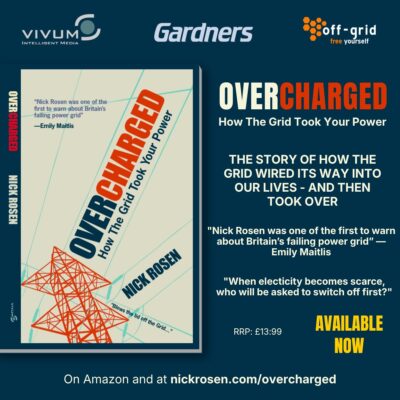
The Centenary The Power Elite Dont Want You To Know About
OVERCHARGED: Nick Rosen’s New Book Explores 100 Years of Britain’s Electricity Grid
A century after Britain’s electricity grid was established, Off-Grid founder Nick Rosen asks whether the system designed to bring electricity to everyone has left us dependent on an increasingly expensive and centralised network.
Nick Rosen, author, journalist and founder of Off-Grid.net, has released his latest book, OVERCHARGED: How the Grid Took Your Power.
Published in September 2026, the book examines the origins of Britain’s electricity grid, the political and economic decisions that shaped it, and the consequences of centralising electricity production over the past century.
With his characteristic wit and irreverence, Rosen takes readers through a hundred years of energy history — and questions whether the system we inherited is still fit for purpose.
How the Grid Took Your Power
In the 1920s, Britain faced a fundamental choice: should electricity be generated locally, close to where people lived and worked, or distributed through a centralised national network?
The development of the National Grid transformed how electricity was produced, distributed and consumed.
Rosen argues that this transformation came at a cost. Small local power stations were gradually displaced, energy production became increasingly centralised, and households grew dependent on infrastructure controlled by governments, utilities and large corporations.
A century later, many of those original debates remain unresolved.
A Century of Energy Politics
OVERCHARGED explores the personalities, political battles and technological developments that shaped Britain’s electricity system.
From early electricity pioneers and the domestic revolution of the 1930s to today’s rooftop solar installations, home batteries, electric vehicles and increasingly power-hungry AI data centres, the book connects the history of electricity with the challenges we face today.
Britain is spending billions transforming its energy infrastructure. But Rosen suggests that the question is not simply how to generate more electricity.
It is whether we should rethink how power is generated, stored, distributed and, ultimately, controlled.
And with artificial intelligence playing an increasingly important role in both electricity consumption and grid management, the book raises another uncomfortable question:
Should we ever allow AI to take control of our electricity supply?
Electricity History Without the Technical Jargon
Despite tackling complex questions about energy policy, economics and infrastructure, OVERCHARGED is written for the general reader.
With humour, historical anecdotes and 40 pages of photographs and illustrations, Rosen makes a subject usually reserved for engineers, economists and policymakers accessible to anyone interested in the future of energy.
The book will be particularly relevant to Off-Grid readers interested in energy independence, decentralised power, renewable energy and alternatives to conventional infrastructure.
Where to Buy OVERCHARGED
OVERCHARGED: How the Grid Took Your Power is available now in paperback.
Book details
- Author: Nick Rosen
- Publisher: Vivum Publishing
- Format: Paperback
- Length: 224 pages
- RRP: £13.99
- ISBN: 9780957432253
The book is available through Amazon and bookshops worldwide.
If your local bookshop does not have a copy, it can be ordered through Gardners …